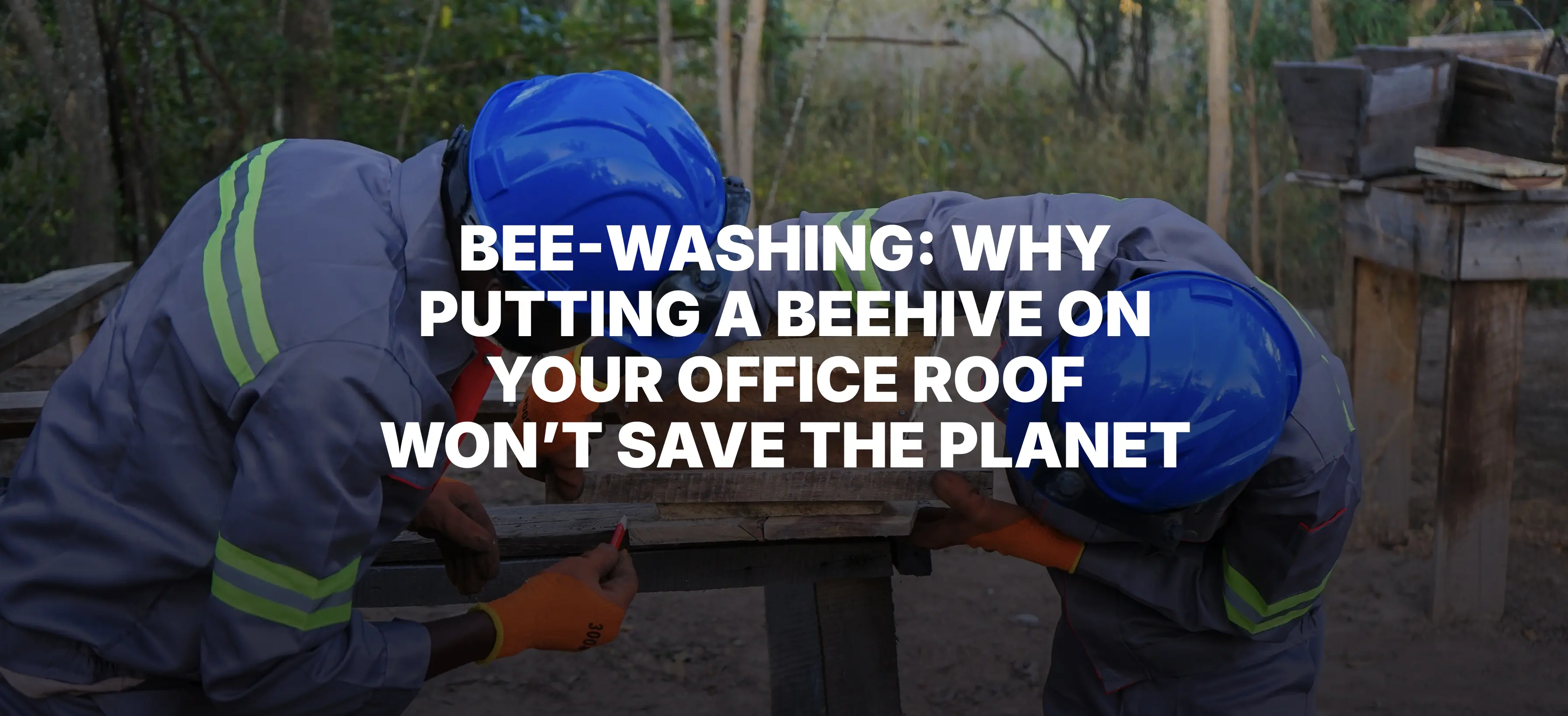
The colorful hive on the office rooftop looks great in the CSR report. It's photogenic, it signals nature-positive thinking, and it delivers the kind of content that works perfectly for corporate branding.
But there's a problem, and it's systemic.
It's called bee-washing: the tendency to use domestic honeybees as a tool for environmental communication, while ignoring the basic rules of ecosystems. And it's becoming one of the most widespread and least recognized forms of greenwashing in the corporate sustainability world.
The term has a precise origin
The concept of bee-washing first appeared in 2015, in a scientific paper by Scott MacIvor and Laurence Packer of York University in Toronto. The two researchers examined one of the most common tools in "save the bees" campaigns: bee hotels, wooden structures marketed as shelters for pollinators. Their conclusion was uncomfortable: without targeted studies on design and real effectiveness, these tools risk being more useful for corporate communication than for ecosystems.
Since then, the phenomenon has spread well beyond bee hotels: hive adoption programs, monitoring sensor installations, branding campaigns tied to honeybees. All initiatives that share one characteristic: they protect corporate image far more effectively than they protect biodiversity.
The problem isn't the bees, it's which bees
To understand why bee-washing is a misleading practice, we need to start from a distinction that many corporate campaigns deliberately ignore: the honeybee (Apis mellifera) is, in every sense, a domestic animal.
It is bred, managed, and cared for by beekeepers. The number of managed colonies globally has increased by 85% since the 1960s. The honeybee is not at risk of extinction, it's at risk of being confused with something it is not.
The species that are genuinely threatened are the more than 20,000 species of wild bees solitary, unmanaged, nesting in the ground, in wood, in plant stems. In Europe, around 9.2% of these species are at risk of extinction. In the United Kingdom, some populations have declined by 52%. These are the true bioindicators of ecosystem health precisely because no one tends to them, their decline directly reflects the state of the environment around them.
The paradox is that massively introducing managed hives into saturated urban or agricultural settings can make things worse: domestic bees compete with wild ones for floral resources and can transmit pathogens that native species have no defenses against. More hives, in certain contexts, means less biodiversity and not more.
Why ecosystems can't be protected one species at a time
There is a conceptual error at the heart of bee-washing worth naming precisely: the idea that protecting biodiversity means protecting a single species.
Ecosystems function as networks: food webs, relationships between soil, plants, insects, vertebrates, microorganisms. Intervening on a single node without considering the network doesn't produce resilience. It produces communication. The key word isn't biodiversity, but biocomplexity: ecosystems in which food webs and all the components that sustain environmental vitality are robust, stable, and in balance with one another.
That's not something you achieve with a hive on a rooftop.
The answer that doesn't come from reports but from the field
This is where a perspective rarely found in the bee-washing debate comes in but for us at Koalisation, it's the starting point.
African wild bees, among the most efficient pollinators in the world, don't need managed hives. They need forests, and forests survive only when the communities living around them have a concrete economic reason not to cut them down.
In Zambia, where we operate, deforestation is not a problem of environmental awareness, it's a problem of economic survival. When burning charcoal is the only available source of income, the forest disappears. Not out of malice, but out of necessity.
Our model starts here: making the forest economically more viable than charcoal. Local communities become beekeepers not as an act of charity, but as an autonomous economic activity that enters the global market.
Wild forest honey becomes an asset. The forest stops being a cost and becomes a resource, and wild bees, as a result, have a habitat that someone has a direct economic interest in protecting.
This is the opposite of bee-washing: not a decorative hive, but a system in which biodiversity conservation is the natural consequence of an economic model that actually works.
What should a company actually do?
Bee-washing thrives because genuinely protecting biodiversity is more complex and less photogenic than installing a hive on a rooftop. It requires projects that address the real causes of pollinator decline: habitat loss, pesticide use, ecosystem fragmentation.
For a company that wants to go beyond communication, the right questions aren't "how many hives have we adopted?" but rather: "Are we funding the regeneration of real habitats? Are we measuring impact on wild species? Are we supporting communities that have a direct economic interest in forest conservation?"
Bees don't need offices, they need forests. And forests need a market that makes protecting them more economically viable than any alternative.
Want to bring this model into your sustainability strategy? Get in touch!