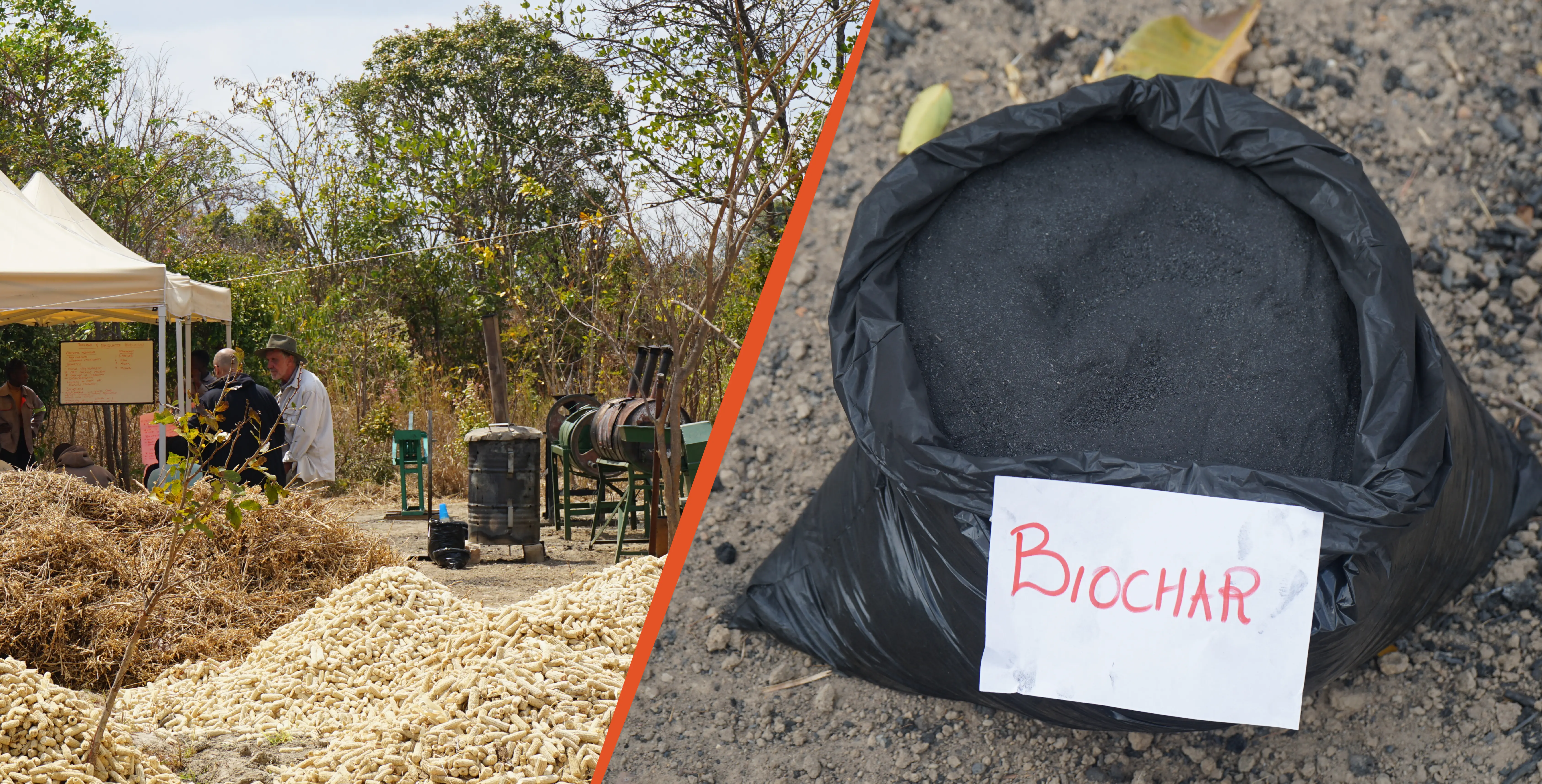
What do an agricultural residue, leftover wood, and waste prunings have in common?
Until recently, nothing. They were waste.
Today, they are the feedstock for one of the most established carbon removal technologies in existence.
What biochar is and how it is produced
Biochar is a solid, carbon-rich material obtained by heating biomass: plant residues, wood, agricultural waste, manure, in the complete or near-complete absence of oxygen. This process is called pyrolysis.
It should not be confused with ash. Ash is what remains after complete combustion: the carbon has escaped into the atmosphere. Biochar is the stable solid obtained by avoiding combustion, keeping the carbon trapped inside. It is this difference that makes everything else possible.
During conversion, part of the CO₂ that the plant absorbed while growing is trapped in a stable form. If the material is incorporated into the soil, that carbon can remain sequestered for hundreds, even thousands of years.
At the same time, biochar improves soil fertility by increasing water retention, nutrient availability, and microbial activity.
Two functions in a single material: carbon sequestration and agricultural regeneration.
The real impact: the numbers
The IPCC has recognized biochar as a carbon-negative technology since 2018.
When it comes to its global potential, however, science does not speak with a single voice. A synthesis of 19 studies published in 2025 in Communications Earth & Environment shows estimates ranging from 0.03 to 11 Pg of CO₂ equivalent per year. This massive discrepancy stems from differences in scope, definitions, and assumptions regarding available biomass. The authors note that many analyses rely on a single, outdated study.
More recent independent assessments converge on a narrower interval: 2.6 to 10.3 Pg of CO₂ equivalent per year. While this remains a wide range, the synthesis reaches a clear conclusion: the evidence for a gigaton-scale contribution is solid.
Moving from theory to practice, the data is leaner and more eloquent: in 2024, biochar accounted for 86% of all durable carbon removal deliveries globally (and 83% cumulatively between 2020 and 2024). It is not just the most promising technology; it is the most delivered.
Biochar in the european CRCF regulation
In December 2024, the European Union established the Carbon Removals and Carbon Farming Regulation, Regulation (EU) 2024/3012, known as the CRCF.
It is the first voluntary, pan-European regulatory framework to certify credits from CO₂ removals, carbon farming, and carbon storage in products. Biochar is formally recognized as a permanent removal technology, provided it meets four criteria: quantification, additionality, permanence, and sustainability.
In February 2026, the Commission adopted the first implementing methodologies. This means that a producer can now generate credits certified according to a recognized European standard. It is no longer an informal market, but a regulated and verifiable system.
This is not a technical detail. It is the difference between a byproduct and a climate asset.
The data that explains everything: two markets, one material
This is where the story gets interesting.
The market for biochar as a physical material was worth approximately $196 million in 2024 and is projected to reach $277 million by 2031. This represents solid but ordinary growth: just over 5% per year.
Meanwhile, the market for biochar carbon credits was worth $181.5 million in 2024. In 2022, it was worth just $14.6 million. That is a compound annual growth rate of 131.6%.
These two metrics are structured differently (product revenue versus contracted volume) and are therefore not strictly comparable. However, the order of magnitude is the same, and the comparison sends a clear message: today, the carbon contained within biochar is worth as much as the biochar itself, and it is growing twenty-five times faster.
The same material generates two revenue streams: one for what it does to the soil, and one for what it removes from the atmosphere.
Why quality matters more than volume
Biochar credits trade at around €125–145 per metric ton of CO₂ on Nasdaq/Puro.earth’s CORCCHAR index: roughly 3 to 5 times more than simple avoidance credits.
Buyers pay this premium for a specific reason. A biochar credit removes carbon durably, is third-party verifiable, and carries a low risk of reversal. It doesn't just promise to avoid future emissions; it removes CO₂ right now and locks it away in a stable form. Furthermore, it delivers quickly: a biochar project can generate credits within six months.
This is also why Microsoft, Google, Swiss Re, and JPMorgan are among the primary buyers. For Swiss Re, biochar makes up nearly their entire durable removal portfolio.
In a market where a large portion of voluntary credits are of low quality, this is the distinction that matters.
Yesterday's waste, tomorrow's resource
Biochar changes an equation as old as agriculture itself: what to do with waste.
A residue that previously held no value can now hold three: for the soil, for the climate, and for the producer. This is not just a slogan; it is an economic model tied to a regulated, measurable market.
It is not declared; it is measured.