Honey has been part of our diet for thousands of years.
We find it in the history of ancient civilizations, in traditional remedies, and today on supermarket shelves as a natural alternative to sugar.
In recent years, honey has once again attracted the attention of scientific research. Beyond its taste and natural origin, it contains a variety of compounds that may have beneficial effects on metabolism, the immune system, and overall well-being.
For this reason, what we often consider a simple sweetener turns out to be a complex substance, born from the interaction between plants, bees, and the environment.
Honey and the logic of a natural supply chain
Unlike many foods in the modern diet, honey comes from a simple supply chain.
It does not require complex industrial processing or long refining procedures: the final product is essentially the direct result of the work of bees and the availability of natural resources in a given territory.
The quantity and characteristics of honey depend on plant biodiversity, flowering seasons, and environmental conditions.
Each variety reflects the landscape; it comes from the composition of local flora and the work of pollinators that make it possible.
For this reason, the honey supply chain represents an interesting model also from a food systems perspective.
In a global context where many food chains are becoming longer, more standardized, and increasingly dependent on complex processing, honey remains one of the few products that preserves a direct connection with its territory of origin.
Understanding this helps us adopt a different perspective: to see honey not just as a food, but as an expression of balance between biodiversity, territory, and food production.
Energy from flowers
When bees transform nectar into honey, they concentrate plant sugars and compounds into a form that our body can quickly absorb.
With a composition made up of about 85% natural sugars, honey represents an immediate source of energy for humans.
Several clinical studies have shown that honey consumption leads to a less pronounced glycemic and insulinemic response compared to refined sugar.
This difference is crucial: while industrial sugar can cause rapid spikes followed by energy crashes, honey appears to support better glucose tolerance and a more balanced insulin response.
For athletes or anyone facing a demanding day this translates into a source of fuel that sustains performance without excessively stressing the metabolic system.
The secret behind honey’s beneficial properties
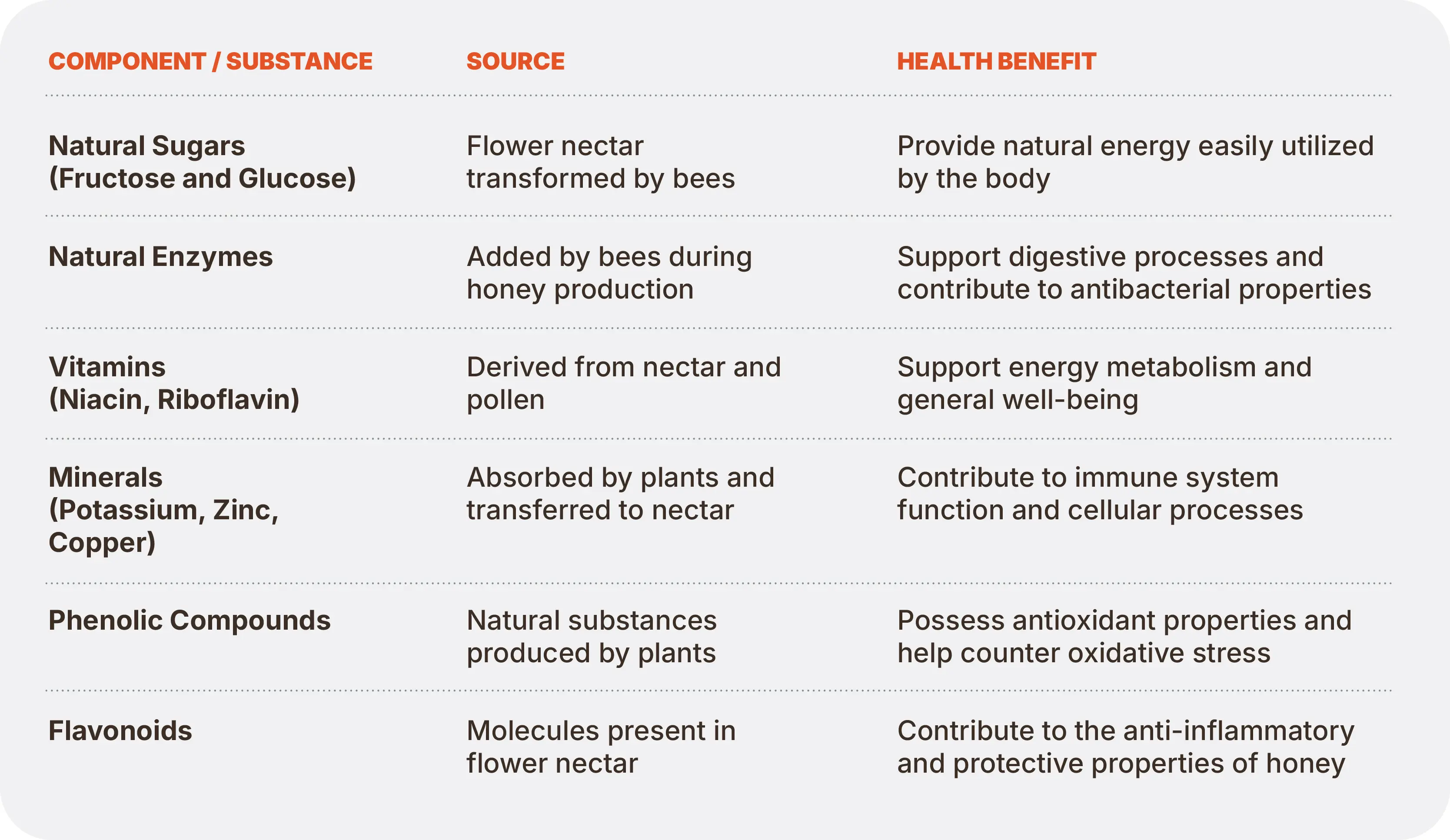
In addition to the benefits mentioned above, honey contains micronutrients that account for only about 0.5% of its composition, yet make a significant difference.
These include enzymes, organic acids, and vitamins.
Among these substances, plant-derived compounds such as flavonoids stand out.
Plants use them to protect themselves from ultraviolet radiation and pathogens.
When bees collect nectar, these compounds are transferred into honey, giving it important antioxidant and anti-inflammatory properties.
To better understand where honey’s properties come from, it is useful to look at some of its components and their role in human health.