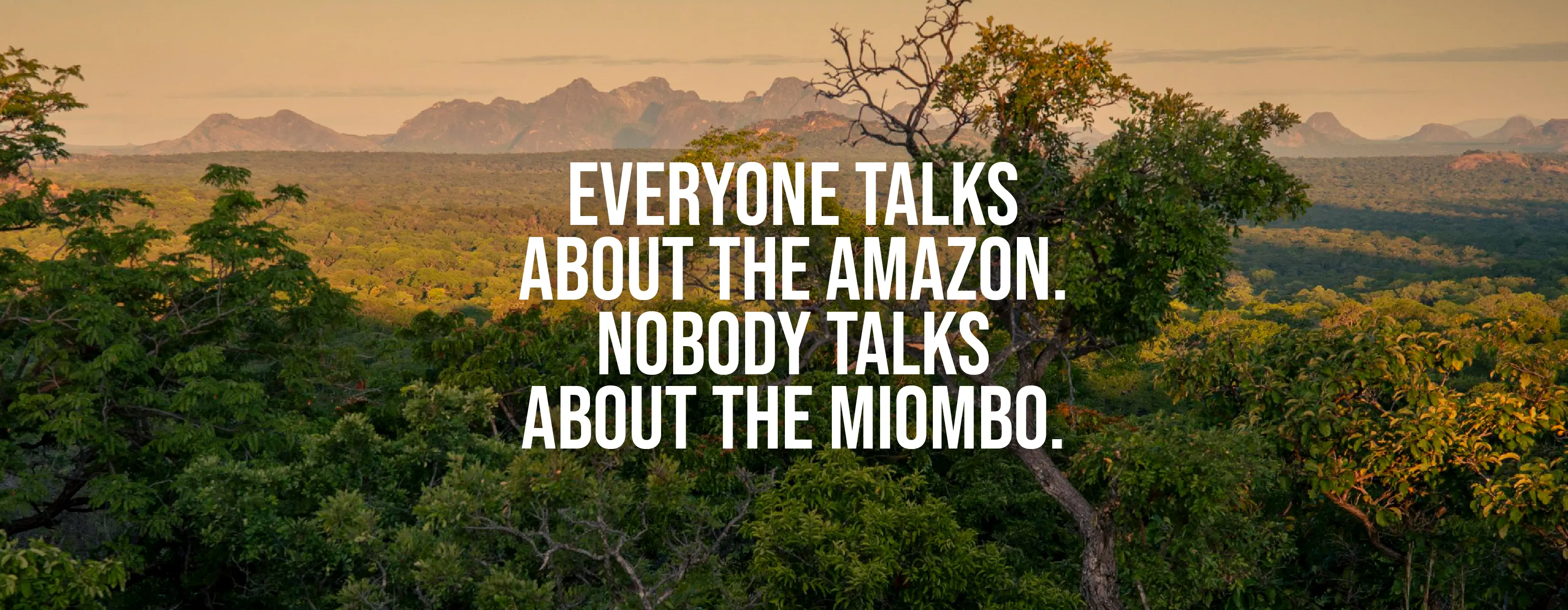
1.9 million km² . 300 million people. Twice as much carbon as we thought. When people talk about African forests, everyone thinks of the Congo rainforest.
Nobody thinks of the Miombo.
Yet, the Miombo is larger. It is more widespread and it is arguably the most important piece of nature you have never heard of.
What is the Miombo forest?
The Miombo is a woodland savanna, a type of dry, open forest spanning over 1.9 million km² across eight Central and Southern African countries: Zambia, Tanzania, Mozambique, Zimbabwe, Angola, Malawi, the Democratic Republic of Congo, and Botswana.
Its name comes from its defining tree: the Brachystegia, locally known as "miombo". It is a tree that doesn't look extraordinary. Yet, it is the backbone of a system that sustains over 300 million people.
The unexpected twist: hidden carbon
For years, the Miombo has been undervalued. It is not a dense jungle. It is not as spectacular as the Amazon. Yet, a July 2024 study by UCL, reported by CNN, completely overturned everything we thought we knew.
The Miombo stores twice as much carbon as previously estimated. We are talking about 3.7 billion tonnes more than China's total atmospheric emissions in 2023. How could it be ignored for so long? The Miombo stores much of its carbon underground, in its roots and soil. It is invisible to the naked eye. Consequently, it remained excluded from standard climate models for a long time, as confirmed by CIFOR-ICRAF research.
It is simply not easy to measure using traditional methods. The UCL study utilized LiDAR, 3D laser technology deployed via drones and helicopters, to map the forest’s volume accurately for the first time. Before this work, standard climate models were systematically underestimating one of the most strategic ecosystems on the planet.
The problem: a strategic forest under pressure
From 1980 to 2020, the Miombo lost nearly a third of its forest cover. This was documented by Dialogue Earth in a detailed analysis of ongoing pressures.
The causes are the usual suspects: subsistence agriculture, charcoal production, urban expansion, and the mining industry. But there is a less visible and equally devastating factor: the lack of international attention. The Miombo lacks the brand recognition of the Amazon. It doesn't have fundraising campaigns. It lacks the spot in the global climate narrative it deserves, despite its essential role in climate regulation, biodiversity protection, and supporting millions of people. When a forest doesn't have a name in public discourse, it's easier to destroy it.
Bringing the Miombo to the center of the conversation is not just an environmental issue. It is a priority for development and climate resilience.
Something is moving
Things are beginning to change. In September 2024, eleven African governments launched the Miombo Restoration Alliance, mobilizing $500 million for ecosystem restoration. In February 2026, the first Article 6 projects were launched, the Paris Agreement's mechanism for international carbon markets. For the first time, the Miombo is concretely entering global climate finance: no longer as a niche environmental issue, but as a strategic asset for decarbonization.
The groundwork for this was laid back in 2024 by the WCS Miombo Initiative, bringing together scientists, governments, and local communities to build a shared understanding of the ecosystem, a mandatory prerequisite for any serious intervention.
The challenge remains massive. But for the first time, the Miombo is being recognized for what it truly is: one of the most strategic natural assets for the climate, economic, and social future of Sub-Saharan Africa.
Why it matters, also for us
This is where we work.
In Zambia, within the Miombo territories, our work ranges from regeneration projects to community infrastructure.
From these very forests comes a honey unlike any other. It is harvested by traditional beekeeping families who hang bark hives high up in the tree canopies. They can do this because the Brachystegia still blossoms. Because the bees still have somewhere to go. Because those trees are still standing.
None of this happens automatically. It is the result of deliberate choices made every single day by the people who inhabit that forest.
Our work starts right there